
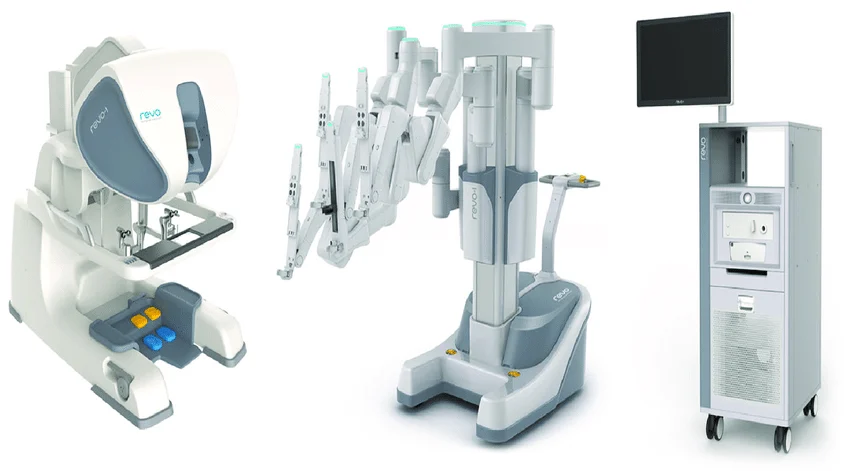
🔆Revo-i vs Da Vinci Xi: Democratizing Advanced Surgery in Africa
Nigeria and its neighbors face a stark surgical care gap. Only about 36% of Nigerian households can afford essential surgery without financial hardship, and less than 5% have health insurance[1]. Across Africa, high costs and few specialists leave most of the population without safe, modern surgery[2][1]. As a result, African patients spend over $10 billion a year on medical tourism – some $2 billion from Nigeria alone[3]. This capital flight not only strains economies but undermines confidence in local care. And yet even small steps toward high-end care can pay dividends: for example, Nigeria’s first robotic surgery center (Nizamiye Hospital, Abuja) is already attracting patients from neighboring countries who would otherwise travel to Europe[4]. Against this backdrop, affordable surgical innovations are urgent.
🔆Africa’s Healthcare Challenges
✅Access & Cost: Rural hospitals often lack basic equipment, while expensive techniques (like standard robotic surgery) remain out of reach. High purchase and maintenance costs (a Da Vinci Xi costs well over $2 million plus annual fees[5]) mean few hospitals can afford them.
✅Workforce Shortages: Surgeons are unequally distributed and in short supply. Nigeria’s surgical workforce per capita is far below targets, compounding delays and cost barriers[1].
✅Financial Drain: Outbound medical travel is rampant. The Nigerian Medical Association warns that Nigeria loses ~$2B/year to patients seeking care abroad[3] – funds that could build local capacity.
✅Policy Opportunities: Leaders note that billions in foreign investment are poised for health (Nigeria expects ~$5B FDI in the next 5 years[6]). Investing in homegrown tech like Revo-i aligns with this momentum, keeping value and jobs in Africa rather than exporting patients and profits overseas.
🔆Revo-i: A Homegrown, Cost-Saving Alternative
Revo-i is South Korea’s first domestically developed multiport surgical robot (approved by KFDA in 2016). Its design intentionally mirrors familiar consoles, shortening the learning curve for surgeons trained on Da Vinci[7]. Crucially for Africa, Revo-i was built with cost-efficiency in mind: all instruments are reusable[8], and the system’s acquisition and maintenance costs are generally lower than legacy platforms[8][9]. In fact, experts estimate Revo-i cuts instrument and service expenses by ~40% compared to Da Vinci[9]. These savings translate into a more affordable per-case cost for hospitals (especially high-volume centers) without sacrificing surgical capability[8][10].
🟩Key Advantages of Revo-i:
✅ Lower Capital and Operational Costs: Reusable instruments and competitive pricing mean up to ~42% cost savings on instruments/maintenance versus Da Vinci[9][8]. Even without official prices, analysts note the Revo-i base system is substantially cheaper than a Da Vinci Xi, making the robotic model viable for budget-conscious institutions.
✅ Comparable Performance: Early trials show Revo-i achieves the same surgical goals. It offers 3D HD vision and wristed instruments for precise work. Revo-i’s console feels familiar (closed-console design) to skilled laparoscopic surgeons[7].
✅ Training and Scalability: Meere Company provides a dedicated Revo-sim surgical simulator for trainees[11]. This three-step program (basic skills, suturing, advanced tasks) can rapidly build local expertise. Wide usability means multiple specialties – urology, general surgery, gynecology – can train on one platform.
✅ Democratizing Access: By bringing costs down, Revo-i lowers the barrier for hospitals to offer cutting-edge surgery. A cheaper system means not only major urban centers but also large regional hospitals can invest in robotics and begin to democratize advanced care.
🔆 Clinical Evidence: Safety and Outcomes
Clinical trials and case series from Korea confirm that Revo-i delivers safe, high-quality surgery. In the first human trial for Revo-i prostatectomy, all 17 patients had successful Retzius-sparing radical prostatectomies with no conversions and no major complications[12]. Hospital stays averaged just 4 days[12]. In 15 patients undergoing Revo-i cholecystectomy, every operation was completed robotically (0 conversions), with negligible blood loss and no bile duct injuries; average stay was 2 days[13]. Similarly, an early trial of Revo-i pancreaticoduodenectomy (10 cases) showed 0% major morbidity and outcomes statistically identical to a concurrent Da Vinci group[14].
✅Matched outcomes: A matched-cohort study (33 Revo-i vs 33 Da Vinci prostatectomies by the same surgeon) found nearly identical results: blood loss, positive margin rates (~45–48%), and complication rates (~9%) were the same[15]. Revo-i cases even had shorter hospital stays, although total operative time was longer during the early experience[15]. This demonstrates that in skilled hands, Revo-i is equivalent to the gold standard for complex urologic surgery.
✅Surgeries & Adoption: By late 2021, Revo-i systems in Korea had performed over 200 surgeries across specialties[16] (see Table below). These include prostatectomies (n≈25), 124 cholecystectomies, dozens of gynecologic procedures, and complex colorectal and pancreatic resections[17][18]. The breadth of procedures tested speaks to the system’s versatility and growing trust among surgeons.
| Revo-i Clinical Case Series (S. Korea) | Outcome Highlights |
|---|---|
| Retzius-sparing prostatectomy (17 pts)[12] | 100% robotic completion; no major complications. |
| Robot-assisted cholecystectomy (15 pts)[13] | 0 conversions, no injuries; 2-day mean stay. |
| Pancreaticoduodenectomy (10 pts)[14] | 0% major complications; matched da Vinci. |
| Propensity-matched RARP (33 Revo-i vs 33 Da Vinci)[15] | Similar margins & safety; shorter stay with Revo-i. |
These results are reinforced by global reviews noting Revo-i’s safety: early studies emphasize equivalent oncologic and functional outcomes in urology, with the main trade-off being a longer learning curve for surgeons[15][9]. Importantly, no study has found any new safety signal for Revo-i; rather, it replicates the benefits of robotic surgery (tremor reduction, precision incisions, less blood loss) at a fraction of the cost[13][9].
🔆Economic Edge and Investment Potential
The economics of Revo-i tilt favorably for Nigerian and African hospitals. Lower capital expense and per-case cost mean a much faster return on investment. For perspective, capturing even 10% of Nigeria’s $2 billion medical tourism outflow would yield $200 million in local healthcare revenue , enough to deploy dozens of Revo-i systems with change left over. Moreover, regional patients are already looking inward: as one commentator notes, countries across West and Central Africa send patients (for kidney transplants, IVF, etc.) to Nigerian centers[19]. A competitive robotic offering could build on this trend.
✅Reduced Upfront Burden: Unlike a $2–3 million Da Vinci, a Revo-i system can potentially be procured for substantially less (industry sources suggest 30–50% lower cost). Financial models and manufacturing reports explicitly project Revo-i to cut instrument and maintenance fees by ≈40%[9]. This means each procedure carries much less overhead, improving the hospital’s margin on advanced surgeries.
✅Operational ROI: Robotic cases typically generate higher surgical fees than open cases. With lower amortized costs, each Revo-i procedure contributes more profit per case. One analysis of similar systems (Senhance vs Da Vinci) showed per-case costs cut nearly in half[20]; Revo-i’s reusable design similarly drives down disposables. As volume ramps up, the hospital recovers its investment sooner.
✅Market Differentiation: Early adopters in Africa will become referral centers. Already, Nizamiye Hospital (Abuja) advertises its “robotic surgery suite” – a draw for regional elites. Policymakers and investors note a strategic shift: “Africa must become a destination for quality healthcare, not an exporter of patients”[4]. Deploying Revo-i could catalyze medical tourism inbound, reversing current trends.
✅Alignment with National Goals: Nigerian leaders stress health industrialization as a growth sector[6]. Funds expected from foreign investment can be channeled into cutting-edge care. Investing in Revo-i suits that narrative: it’s a high-return, high-impact investment that builds skills domestically and keeps healthcare spending within Africa[21][3].
🔆Building Local Capacity
Revo-i’s affordability and training programs also address the human-side of surgical care. Hospitals can start with one unit and train multiple specialties, multiplying impact. The Revo-sim system (a built-in simulator) lets surgeons and nurses rehearse robotic maneuvers in a virtual OR[11]. Customized curricula (already in use in Korea) would allow Nigerian training centers to certify teams without needing foreign fellowships. With tech transfer and partnerships, local biomedical engineers could even learn to maintain and service robots, reducing dependence on expatriate support.
Crucially, the user-driven development model of Revo-i (open R&D) means feedback from African surgeons can be incorporated over time[22]. Early adopters in Nigeria will find themselves in collaboration with the manufacturer – a rare chance to tailor a global technology to local needs. This inclusive approach (“open research and development”[22]) contrasts with black-box systems and promises faster adaptation to African OR realities (power fluctuations, equipment constraints, etc.).
🔆Conclusion: A Call to Action
The choice for African health leaders is clear: emerging surgical robotics are no longer a curiosity but a strategic necessity. As the World Bank and African Union urge better healthcare investment, Revo-i offers a tangible path to both improved outcomes and economic development. For Nigeria and its neighbors, the question isn’t if robots will come, but which ones and when.
By choosing Revo-i, policymakers and hospital boards can leapfrog cost barriers and expand access simultaneously. This is not just about technology for its own sake: it’s about empowering surgeons and patients. It means a Nigerian tertiary hospital performing its first robotic prostatectomy or hysterectomy – instead of sending the patient to Europe or Asia. It means keeping billions in-country and building African excellence on home soil.
The evidence – clinical and economic – is compelling. Revo-i has proven safe, effective and far more affordable[15][9]. The demand is there, as shown by early success stories and patient flows[4]. Leaders must act now, allocating resources and creating incentives for robotic surgery programs. We have a generation of skilled surgeons ready to train on new platforms, and a population desperate for high-quality care.
Health investors, hospital CEOs, and policymakers: the time to partner with Revo-i is today. Embrace this catalyst for change – it promises not only financial returns, but the chance to democratize advanced surgery across Africa. The continent’s patients deserve nothing less than the “robotic revolution” that affluent nations enjoy. Let Revo-i be Africa’s tool to catch up, to innovate, and to become, as Nigerian leaders envision, a maker of medical breakthroughs, not just a market for them.
#NizamiyeHospitalAbuja#roboticsurgery#Revorobotics#DaVinci#Phinnastadsbiomedicalltd
Reference
[1] Access to quality surgical care in Nigeria: A narrative review of the challenges, and the way forward – ScienceDirect
[2] Robotic Surgery in Africa: History, Contemporary, and Thereafter – PMC
[3] [4] [6] [19] [21] Africa loses $10b to medical tourism, NMA urges investment in healthcare
[5] [7] [8] [10] [20] Beyond Da Vinci: Comparative Review of Next-Generation Robotic Platforms in Urologic Surgery – PMC
[9] New multiport robotic surgical systems: a comprehensive literature review of clinical outcomes in urology – PMC
[11] [16] [17] [18] [22] Lee, H. K., Lee, K. E., Ku, J., & Lee, K. H. (2021). Revo-i: The competitive Korean surgical robot. Gynecologic Robotic Surgery, 2(2), 45–52. https://doi.org/10.36637/grs.2021.00059
[12] Chang, K.D., Abdel Raheem, A., Choi, Y.D., Chung, B.H. and Rha, K.H. (2018), Retzius-sparing robot-assisted radical prostatectomy using the Revo-i robotic surgical system: surgical technique and results of the first human trial. BJU Int, 122: 441-448. https://doi.org/10.1111/bju.14245
[13] Lim, J. H., Lee, W. J., Choi, S. H., & Kang, C. M. (2021). Cholecystectomy using the Revo-i robotic surgical system from Korea: the first clinical study. Updates in Surgery, 73(3), 1029-1035. https://doi.org/10.1007/s13304-020-00877-5
[14] The Revo-i Robotic Surgical System in Advanced Pancreatic Surgery: A Second Non-Randomized Clinical Trial and Comparative Analysis to the da Vinci™ System – PubMed
[15] Comparing Revo-i and da Vinci in Retzius-Sparing Robot-Assisted Radical Prostatectomy: A Preliminary Propensity Score Analysis of Outcomes – PubMed
Recent Posts
-
 🚨 THE ROBOT THAT OPERATES WHERE HUMAN HANDS CANNOT 🚨Virtuoso® Surgical Robotics Is Redefining Minimally Invasive Care In Africa
 -
🔆Virtual Incision’s MIRA™ Robotic Surgical System : Clinical Evidence, Healthcare Impact, and Strategic Value for Nigeria and Africa.
-
🔆Titan Medical’s SPORT Single-Port Robotic Surgical System — Clinical Feasibility, Healthcare Transformation, and Strategic Value for Nigeria and Africa
-
🔆Think Surgical, Inc. Orthopedic Robotics for Precision Joint Replacement: Clinical Evidence, Healthcare Impact, and Strategic Value for Nigeria and Africa.
-
🔆The da Vinci Xi Robotic Surgical System and Its Clinical Applications, Global Impact, and Strategic Deployment for Nigeria and Africa


